For years, digital inkjet printing transformed patterns and graphics in the fashion industry, but it always hit a hard wall when it came to fabric dyeing. Standard inkjet nozzles apply tiny, delicate droplets that sit strictly on the surface of a material. That works incredible for a printed graphic, but it leaves inner fibres completely untouched. The proprietary liquid application technology powering the Dye-to-Service model fixes this exact bottleneck, achieving deep, rich colour penetration without forcing dyehouses to submerge textiles in massive, polluting water baths.
Going Beyond the Limitations
In the technology behind the Dye-to-Service, the application operates as an open system. Dyehouses can run their existing traditional colorants and chemical formulations, eliminating the need for costly custom consumables.
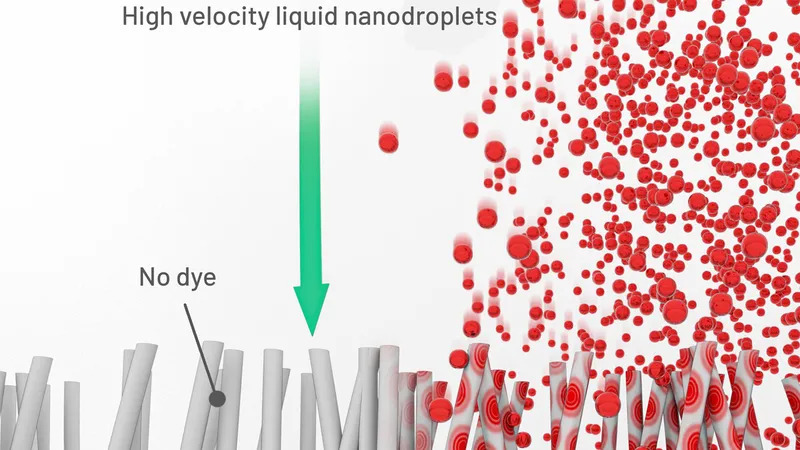
More importantly, the technology delivers liquid in much larger droplet volumes at significantly higher velocities. Where standard inkjet nozzles gently jet microscopic droplets that rest on top of the weave, high-velocity jetting fires liquid deep into the core of the textile structure. It turns a technology that was historically limited to surface printing into a true, full-penetration dyeing process.
Targeted Airflow for Deep-Fiber Penetration
Achieving consistent, streak-free colour across different fabric structures requires precise control over how fluid hits the material. The Dye-to-Service system manages this by combining its application technology with targeted airflow streams. By manipulating air currents around the droplet spray, operators can adjust exactly how and where the dye lands on the substrate.
This airflow integration ensures that heavy, dense textiles absorb color just as evenly as delicate, thin weaves, giving manufacturers total control over color placement without resorting to chemical baths.
Flexibility for Every Fabric Type
Because the entire process runs on a fully digital framework, adapting to different material weights is seamless. Operators simply dial in the required droplet density and volume digitally rather than changing hardware components. On a standard 1.8-meter machine width, the technology adapts across a vast array of textile categories:
· Lightweight Apparel & Activewear
· Mid-Weight & Technical Fabrics
· Heavyweight Wovens & Knits
By removing proprietary chemical restrictions and offering dynamic control across any fabric weight, the engineering behind the Dye to Service model gives dyehouses maximum operational flexibility alongside a drastically reduced environmental footprint.
Find out more about the Technology Behind Dye-To-Service by Alchemie Technology, below:
Dye-to-Service Explained: The Future of Textile Dyeing by Alchemie Technology